

Two colored contacts both say 14.2 mm, yet one seems to make your eyes look larger. The other changes the color without creating the same impression. How can that happen?
The short answer is that lens diameter measures the whole lens, not just its visible design. The printed area, outer ring, and color transitions help determine what you notice. Your own eyes and the photographs you compare matter too.
An enlarging effect is a visual impression. Contacts do not physically increase your iris or eye size. This guide explains which design details to compare, with two Godestar examples sharing the same listed diameter.
The Quick Answer: Compare More Than DIA
DIA is the full diameter of the contact lens. Graphic diameter, often labeled G.DIA or GDIA, describes the diameter of its printed design. A transparent margin may extend beyond that design.
Two lenses can share one DIA measurement while their printed areas differ. Even matching graphic diameters do not guarantee matching effects. A dark, distinct border can look more prominent than a softly fading edge.
- Full diameter: the size of the complete lens.
- Graphic diameter: the stated width of the printed design.
- Outer-ring design: how sharply that design appears outlined.
- Your eyes: the original color and visible iris influence the result.
Think of DIA as one specification, rather than a beauty-effect score. It cannot tell you whether a design will look subtle, defined, or dramatic on you. It also cannot establish whether a lens fits.
Same Lens Diameter, Different Printed Area
Imagine two hypothetical lenses with a full diameter of 14.2 mm. One has a 12.8 mm graphic diameter. The other has a 13.4 mm graphic diameter. Their outer lens boundaries match, but their printed boundaries do not.
The second printed diameter is 0.6 mm wider overall. In a centered, flat drawing, that equals 0.3 mm more on each side. This is geometry, not a prediction of visible enlargement on an eye.
A larger printed region can create a broader visible design, depending on its opacity and relationship to your iris. A pale, feathered edge may be less obvious than a smaller but darker outline. The number and the pattern work together.
Why Graphic Diameter Is Useful but Incomplete
Graphic diameter tells you something about the design's extent. It does not describe every dot, gap, or color transition. Two prints with equal outer dimensions can distribute their color very differently.
Check the product's stated graphic diameter when available. Then inspect its pattern and wearing images. Do not estimate missing measurements from a photograph or treat a marketing image as a precise scale drawing.
The Outer Ring Changes the Visual Boundary
The iris can appear bordered by a dark limbal ring. Some cosmetic lenses add a pigmented ring near that visual boundary. This can strengthen definition and contribute to an apparent larger-iris effect.
A published study of cosmetic contact lenses describes pigmented ring patterns used for this appearance. It does not establish which Godestar product will look largest on you.
Defined Ring Versus Soft Edge
A dark, clearly outlined design may draw attention to the outside of the iris-like pattern. A fading edge can blend more gradually with the original eye color. That difference may change perceived definition even when the printed diameter matches.
Look at the thickness and darkness of the outline, not only whether a product says “limbal ring.” A delicate ring and a dense black ring are different visual choices. Neither guarantees a particular result.
Color and Pattern Can Change the Impression Too
Contrast With Your Natural Iris
A print close to your natural eye color may appear less conspicuous. A contrasting shade or dark border can be easier to notice. More noticeable color is not automatically the same as more enlargement.
Compare the outer boundary separately from the brightness of the center. A bright lens can attract attention without adding a strong outline. A darker design may emphasize shape without looking especially bright.
Dots, Gradients, and the Center Opening
Printed dots and gradients control how the design transitions into unprinted areas. A clear center opening is another visible part of the pattern. These details affect the overall impression without changing the full lens diameter.
A lens-pattern image helps you inspect those details. It cannot show exactly how the lens will sit on your eye. Do not infer comfort, visual performance, or medical suitability from the printed design.
Your Eye Shape and the Camera View
People have different visible iris sizes, eyelid openings, and natural iris colors. Pupil size also changes with lighting. The same design can therefore occupy a different proportion of what you see.
Close-up framing, camera distance, and makeup can further influence a picture. Compare similar views before deciding that one lens enlarges more. Different models in different lighting do not provide a controlled comparison.
Two Godestar Designs With the Same Listed DIA
Natural Chocolate and Dark Halo Brown both list a 14.2 mm full diameter in their current specification images. Their graphic diameters differ slightly. More importantly, their product galleries give you different patterns to inspect.
| Product | DIA | G.DIA | What to inspect |
|---|---|---|---|
| Natural Chocolate | 14.2 mm | 13.7 mm | Brown coloring and the transition at the printed edge |
| Dark Halo Brown | 14.2 mm | 13.6 mm | The dark outer pattern and black-brown contrast |
The 0.1 mm difference does not justify ranking their apparent size. Pattern, contrast, and your eyes still matter. These examples show why matching DIA values do not describe the complete cosmetic design.
Natural Chocolate: Inspect the Brown Transition
Use Natural Chocolate's gallery to examine its brown coloring and edge treatment. Compare an eye close-up with its lens-pattern image. Notice where the print becomes less visible rather than assuming every brown lens looks understated.
View Natural Chocolate's product images and current specifications.
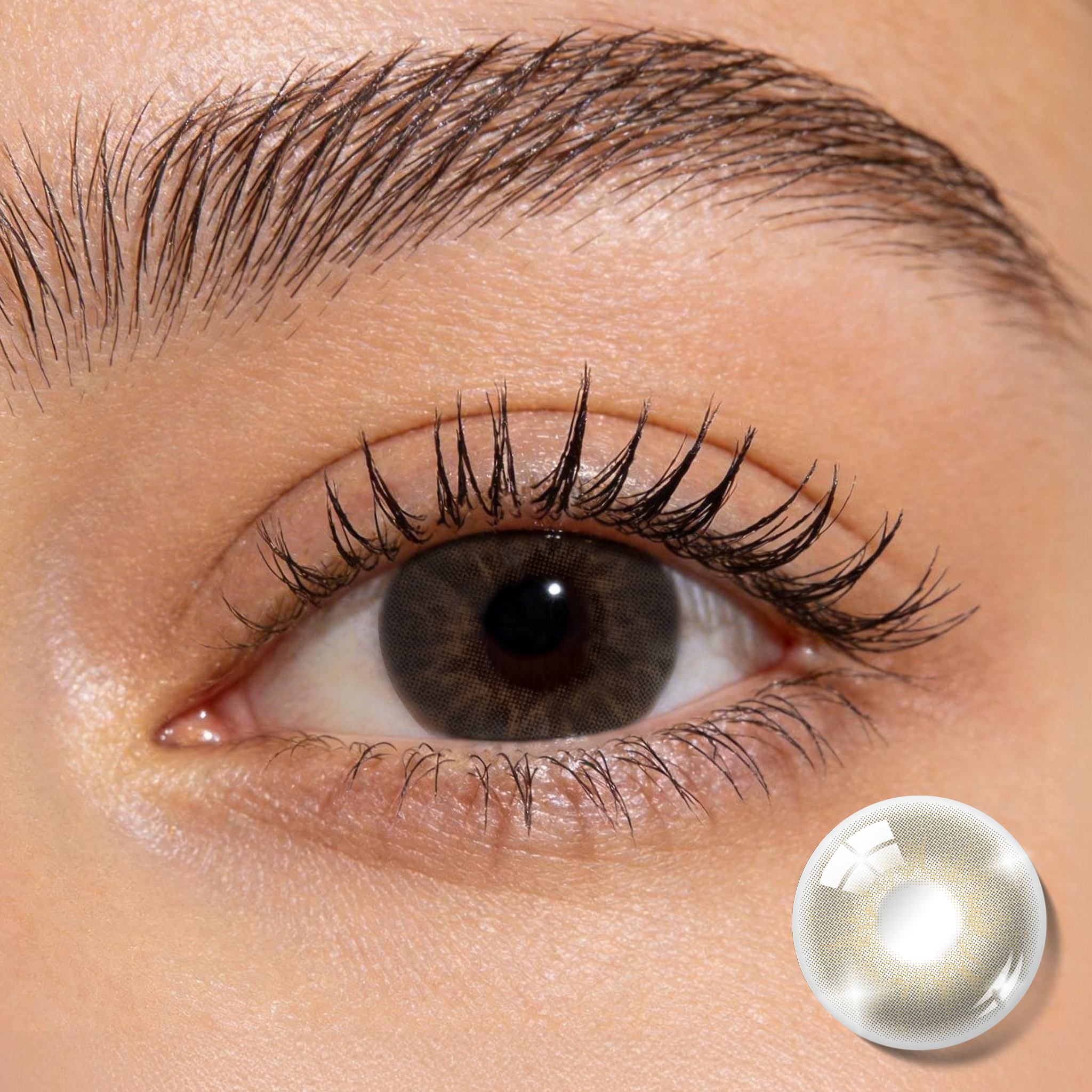
Dark Halo Brown: Inspect the Outer Pattern
Dark Halo Brown gives you a black-brown design to compare with the brown reference. Look for the dark outer pattern and its transition inward. Judge those details directly, rather than relying on “big eye” wording alone.
Explore Dark Halo Brown's gallery and available options.
These galleries use different images. We have not measured enlargement or conducted a same-person wearing test. The article does not claim that either product will look larger, fit better, or feel more comfortable.

A Better Way to Compare Before Buying
- Define the look: subtle color, stronger definition, or a more noticeable iris-like pattern.
- Read both measurements: distinguish full DIA from G.DIA when both are provided.
- Inspect the outer edge: check its darkness, width, and degree of blending.
- Compare similar images: use close-ups and full-face views with ordinary lighting.
- Confirm your prescribed lens: ask your eye care professional about suitability before changing products.
If a listing omits graphic diameter, ask for the specification instead of guessing. Avoid assigning universal “natural” or “doll-eye” thresholds to particular numbers. Different patterns and eyes prevent that kind of certainty.
For a broader overview of choosing and using lenses, read our colored contacts guide for beginners.
Fit Is a Separate Question From Appearance
Matching diameter values do not make two lens products interchangeable. A professional fitting considers more than one measurement. Do not increase DIA or change base curve simply to pursue a stronger cosmetic effect.
In the United States, colored contacts require a valid prescription, including zero-power lenses. The FDA explains why an examination and proper fitting matter. Follow your prescribed wearing schedule and the product's care instructions.
If you develop eye pain, redness, or reduced vision, remove the lenses and seek prompt professional advice. A visual preference should never override discomfort or a change in sight.
Frequently Asked Questions
Do 14.2 mm contacts always look smaller than 14.5 mm contacts?
No. Those values describe the full lenses. Printed coverage and edge definition can differ, so the larger DIA does not guarantee greater apparent enlargement.
Does a larger graphic diameter always create a bigger-eye effect?
Not always. It describes a wider print, but the visibility of that print depends on its design and your eyes. Use it alongside pattern images.
Can two lenses with the same G.DIA still look different?
Yes. Ring darkness, fading edges, color density, and center transitions can differ within matching printed boundaries. Equal measurements do not mean identical designs.
Does a dark outer ring mean the lens is larger?
No. The ring is part of the printed design. It may emphasize a visual boundary without indicating a larger full lens diameter.
Can I choose a new lens using diameter alone?
No. DIA alone does not establish fit, comfort, or suitability. Follow your eye care professional's prescription and advice about the specific lens product.
Why does the same lens look different on my friend?
Your original iris color, visible iris size, eyelids, and lighting may differ. A friend's result is a reference, not an exact prediction.
Choose the Design With the Whole Picture in Mind
Start with the prescribed lens options suitable for you. Then compare the printed area, outer ring, pattern, and wearing images. Full diameter is one piece of information, not a promise of a particular appearance.
Explore Godestar Lens Designs